Thursday, April 9, 2009

Compost, Snakes and Dams

Spring has sprung and we are busy as the bees. Here on Denman there is plenty to do on the farm; and course and consultancy have us in Vancouver on a weekly basis.
It's compost mania and we are having a lot of fun putting together different composts with different combinations of material. First, on Denman we had our lovely guest Jill from Green Temple Design helped us gather seaweed, leaves and other compostable materials and put it together. It was heaps of hard work but we gathered enough to make a go of it. We mixed the compost by measuring in big buckets ratios of Carbon and Nitrogen. We then used a bit of blood and bone left over from the garden construction and of course the magic ingredient of urine. On top of all that we put some comfrey tea that we've been brewing for the last few months and it only added to the already powerful odor. We decided to put in a chimney because we were sure that it was going to get very hot. We've used this method before, it keeps the pile from getting too hot and it worked well by allowing some of the heat to escape. The next day Jill and Jesse headed back to Vancouver to make more compost and I prepared seedlings and worked on the orchard. In Vancouver the permaculture design group put together their own compost pile using different materials not the least of them being several dead pigeons. The loft in the barn where Jesse gathered some hay had dead pigeons and owls and well... why not? The pile was made in our friend Jared's back yard in east Vancouver. I was not there for the initial turning but didn't have to be to know that this was one spicy hot concoction. When given some time and flipping around by Jared this pile evened out nicely. No more pigeon evident.
Back on the Island things are doing very well. The weather is beautiful, although, it may be leaving us soon. That is fine with us as some very
vigorous planting has gone on and we would love to have it rain now. Only one of our gardens was ready and organized for a planting blitz but we took to it as soon as we had a chance. I went a little crazy and got a lot of my seeds started many weeks ago so it was definitely time to set some out. While planting we discovered a small colony of snakes living in our garden. At first I was concerned that there were so many but then I found out they eat slugs. I had not thought of snakes when it came to controlling those who wish to eat my greens. So we took a picture of one of the more friendly snakes and he/or she was very compliant and very beautiful. Off to the town of Mission now to put in preliminary markers for some dam and swale systems for two lovely part-time homesteaders. Maybe we'll do some composting there as well. The well turned compost pile will be our cairn. Rather than leaving behind a pile of ruble to mark our place we will leave a piled humus cairn.

Sunday, March 15, 2009

Permaculture in the fast lane

In the past three months, every time I have tried to sit in front of this machine and tell a tale I find myself pulled away by other things. In order to catch up I will be light on words, and heavy on pictures. Do not mistake a lack of words, for little to say. More likely I have too much to say, I just wish to get up to speed and on to new things, as we have a lot happening this coming season.In January we taught two Introduction to Permaculture workshops. One was held in Calgary and the other in Canmore. We had a really great time and met some wonderful individuals, doing amazing things for the world. We made some new friends, Rob and Michelle Avis, and had a great exchange of information and ideas in regards to permaculture in BC and Alberta. We took the opportunity to visit some family and friends, while in Alberta, and were able to get to some pretty spots. When we arrived it was around -20 degrees in Calgary and two days later we went to Edmonton where it was -39 degrees. I have never been so cold before, but there is a special kind of beauty in a landscape so stark.
Permaculture is going wild and spreading across the province of Alberta at a blistering pace. With the energetic and dedicated contributions of Rob and Michelle, permaculture is gaining ground in the prairies. If you are interested in more courses being held there this summer check out Ravis Sustainable. While in Alberta, we had the honor of hosting our first children in an Intro class. Despite our hesitations, these to young eco-warriors exceeded expectations and added immensely to the experience.
We returned from Alberta at the beginning of February. Once back on the coast Jesse gave a series of talks and seminars in and around Vancouver. They all went very well and, while Jesse was a sharing our experiences with others, I was back on the farm pruning the apple orchard. In order to stay where we are and do what we do there is a certain amount of work that has to be done, on the farm. In between the work on the farm we surveyed our garden site to render a design and plan for the coming season.
At the end of February it was off to Kelowna, for the Building Sustainable Communities Conference put on by the Fresh Outlook Foundation. We were excited about this conference, as it was the very first invitation we received when our web site was launched in May of 2008. It was a great opportunity to share permaculture and our experience with members of the private, academic, and government sectors. The response was fantastic.
A day after the conference we were back on the coast to teach an Introduction to Permaculture workshop in Vancouver. With a full house and a lovely group of people it went very. Several of our students from that course have since enrolled in full length PDC course with us, it gives us a great sense of accomplishment to have such positive feed back. Hopefully we can assist some of these active and inspired people get on their feet, as teachers in the coming months. It is only through empowering local teachers and designers that we are going to turn the environmental boat around.
At the beginning of March we are back on Denman Island. For the next few days we worked hard to get our garden prepared for the coming growing season. We continued on from the surveying and planning phase into implementation. It took about one day of hard work to get most of the garden in place. This is the before picture, as we are trying to fix a gutter for rain water to flow into the garden off the roof.
We made on contour level pathways and used the rock that we pulled out of the site to help prop up three beds. We cover cropped and planted some mint and strawberry, both great crawling perennials, to help keep back the grass and weeds along the edges. This is to be an annual greens garden with a strong edge of perennials to help fill the space nature would otherwise fill for us. Below is a picture of the end product shaped, seeded and mulched.
I started my seedling early so that I can have nice strong plants to put in the garden this year. I was also a bit too excited and hopefully I am not too far ahead of the game. Gardening in a more northern area is going to be interesting but it is going very well so far.

And in our spare time...... well there is not much of it around but we do like to enjoy the island now and again. A few weeks ago we went out and dug a few dozen clams for Manhattan clam chowder. Even when we are playing we are working, we always try to come home with wild harvest food from our days off!!!
So here we are, garden planted, rain falling, seedlings growing, part time PDC starting on March 21st and now we have a crab trap out in Baynes Sound filling with food as I write. Busy, busy, busy and I haven't even mentioned what is on the horizon...another aid project?

Thursday, December 11, 2008

Permaculture....more than organic gardening!!! Part 2

Energy Components
Technologies, Connection, Structures, Sources

When designing and establishing systems we must prioritize our investments first in structures and technologies that create energy, second that save energy and last that consume energy. It is inevitable that we will spend energy to initially establish our habitat. This is not a problem, so long as the designed habitat produces more energy over its lifetime than was initially spent. All systems should provide their own energy needs and remove themselves as much as possible from a dependence on distant sources. “When the needs of a system are not met from within, we pay the price in energy and pollution.” (Mollison)

When designing to the site-specific components the first priority is water, as water is an energy that can be put to great use. Higher elevation rainwater storage (earth dams and tanks) should be designed into a landscape whenever possible. This is done to provide gravity fed water for crops houses and other uses at lower elevations. Swales are always planted to trees. They are tree-growing systems. The trees use water harvested by swales to turn the suns energy into wood and foods, like nuts and fruit. The wood can be used to build and maintain structures, provide fiber and heat, for solar efficient homes, in high efficiency stoves. By first investing in the water structures we have created numerous energy storage in our settlement.

Social Components
People, Culture, Trade, Finance

Cooperation not competition is the key. Presently my wife and I live on an apple orchard, together we contribute 40-50hr/week of our time and energy to the orchard. We are not the owners. In exchange for our efforts, we get a roof over our heads, clean and healthful food from the garden, access to land for our own food production and a good community. Assessing this arrangement from a purely financial perspective would neglect all other levels of wealth that we obtain from the relationship. Further more we can be assured that a significant proportion of our time and energy will stay within the systems on the farm. If we were to have regular jobs, within the formalized economic system of distant capital and finance, most of our time and energy would inevitably by exported out of the local environment and economy. By working to keep our time and energy cycling in the local economy through a non formalized system of exchange: trade barter and cooperation, we work to ensure our efforts go towards building the health and security of our community. We reduce our need for monetary gain, as our basic needs of clean food, clean water, clean shelter and healthy community are produced through our basic day-to-day interactions.

Abstract Components
Timing, information, ethics

Without an ethic or belief structure and actions in relation to survival on our planet, permaculture has no starting point. The basic permaculture ethic is as follows:
Care of the earth
Care of People
Return of Surplus to the above two ends (can also be understood as setting limits to growth)
With the ethic as our sounding board, we can use all available information to design healthy communities and provide for those communities without degrading local and distant ecology. In order to spread good design we must spread information to where it is needed and assist others who are trying to learn. As much as we need to combat against a lack of information, we should guard against an over abundance of data. “Information is only a resource if acted upon.” (Mollison) At some point we need to take a step forward and get our hands dirty.

It is only through the functioning connections between components that a complete whole system design can be achieved. The designed systems must maintain and build the health of the local environment and work for its occupants, not distant sources of capital, if it is to be sustainable. This can only be achieved by analyzing the needs and products of various components and placing those components where they supply each others needs and best utilize the inherent energy flows of the landscape and climate. Organic gardening is vital to any sound design, as we all have a right to clean food, but it must be placed appropriately within the context of the whole systems design that is known as permaculture.

Saturday, November 22, 2008

Permaculture....more than organic gardening!!! Part 1


It is often the case that permaculture is mistaken for being just another form of organic gardening. This description is seriously lacking when considering permaculture and the influence it is having, and can have, in our rapidly changing world. “Permaculture is a design system for the harmonious integration of landscape and human habitat” (Mollison) An organic garden is only one element, an important element, but only one in an infinite number of different elements that might make up appropriately designed human systems. At the heart of good design are the functional relationships between elements and how they support each other. Permaculture is not about finding new and complicated high tech ways to support our present culture of waste and "protracted thoughtless labor". It is about integrating: site, energy, social, and abstract components to provide for human needs by creating and recycling resources and energy without degrading local and distant environments.
In the next few months we will be developing our own water, food, and animal systems here on Denman Island. Our system will be designed to provide for more than our own personal needs, as we are offering permaculture design courses and bringing in many people. As we go through the design process we will write about our efforts to implement permaculture design. Win , lose or draw we will reveal how easy or difficult it is to design a 1/4 acre lot starting from our front door. Through the process we will demonstrate how permaculture design is so much more than organic gardening.
Permaculture is not a hippie movement or a religion. Permaculture is a practical ethical way to move forward in a world of uncertain futures. The more we take responsibility for the cycle of resources around us, the richer and more abundant day to day life will be. The more connected we become to our community the more it will be there for us in the future.
http://www2.kenyon.edu/projects/Permaculture/ryan.jpg

Site Components
Water, earth, landscape, climate, plants

An appropriate design first considers local conditions and then harmonizes developed systems with those conditions to achieve that highest level of energy conservation possible.

Water, Access, Structures

This is the priority sequence of permaculture site design. By first designing water infrastructure (swales, dams, irrigation lines, diversion drains, irrigation ditches…) to harvest rainwater and store it passively throughout the landscape, we insure the fertility of the land and soil into the future. By storing, soaking and spreading water throughout the landscape we have preserved and even increased the health of the local ecology.
With the water system designed we can now turn our attention to accesses. The roads and trails must harmonize with the water system. All run off from roads and trails is directed passively to water harvesting structures like swales and dams. The compacted and sealed nature of access features results in flash run off during rain events. In a standard civil enegeneering situation this run off is a problem resulting in numerous logistical and environmental problems. In a harmonized permaculture design the run off from roads and trails are resources easily put to use in the whole system.
The final step in design, structures, is now easy, as building sites will become obvious against the backdrop of designed access and water. All water runoff from house and building sites is easily directed to the water systems.
The pattern of settlement development described above enriches the local environment through increased year round moisture, increasing the productivity of local soil conditions, often resulting in a surplus of usable energy as water stored in small earth dams up slope. The inceased moisture in the environment produces an ecology that supports and provides for the local inhabitant. Residents are required to use only enivronmentally safe products and activities, as any pollution produced is not carried away with the rain water but stays on site in the water harvesting structures. This is the ultimate feedback loop! In a permaculture design if we posion our environment we directly poison ourselves!!!

We have more to come in Part 2 "Energy Components" be sure to check back next week...

Friday, October 31, 2008

Harvest time and Hibernation


Halloween is here and the harvest of the apples is nearly over. Since our return to Canada things have been non-stop. I have had some spare time here and there, between bags of apples, I have be teaching myself the basics of home food preservation. So far I have been met with little success. I have managed to ruin twelve jars of yummy blackberry apple sauce because I did not process them correctly. I nearly cried when I saw the white fuzz on the inside of a jar I opened. I have learned my lesson, though and am thankful that I live in where there are no penalties for such error, only opportunities to learn.
Besides, there are heaps of apples left to experiment with and I'll be sure not to make the same mistake .....more than twice at least !! There will be time for all the indoor stuff as it cools and there is less to do outside.
West coast Canadian weather is just how I remembered it, a wacky mix of teasingly warm and sunny then incredibly wet and dreary. Just three days ago I was in a Tee shirt wondering if I should take a jump in the lake. Now, it hasn't stopped raining since yesterday afternoon and its tough to keep the chill away. I often have my nose pressed to the glass door window in amazement watching the rain fall all day long. I go to bed expecting it to have stopped, but it's still raining in morning. I thought that it would be a cleaver idea to water our indoor herb garden whenever it is raining in an effort to mimic the rain. But now I worry that I may drown our plants. I'll use a different method to remember watering them from now on. Other than my over zealous liquid sunshine our indoor pot garden, which is in the main kitchen window, is doing great. I went to the main garden a couple weeks ago and started potting up parsley, marjoram, oregano, chives, mint and purchased a rosemary plant. While I was doing that, at the markets, Jesse met a lady selling little stevia and gotu kola plants and bought one of each. So now we have the beginning of a mini jungle on the inside and it is starting to produce modestly.
It is important to us to have that fresh nutrition available when the winter comes and extend our season.
As we are drawing inwards, so to are other creatures we share space with. When we arrived here at the farm we noticed ladybugs were everywhere. In the orchard they fly everywhere often crashing into my face and ears. Now that the weather is cool they have done a little ladybug march into our house. At first we would just see them on the walls and one or two flying about. Then we realized that they were congregating by the main door. A little pile of ladybugs all squished together. Jesse reckoned they would just die there and that would be that. I was convinced something more complicated was at work.
So... I googled it!
And this is what I found out....
Ladybugs live off of their stored fat during hibernation, which is why I don't see them moving much. So, now when I get a lad bug flying on my arm I take them over to hotel hibernation and I see a few more have found their way to this spot on there own. Each female is capable of producing 10,000 eggs a year and they can live for two or more years. So in short these Ladybugs spending the winter in our house will be a big help to the gardens and orchards next year.

Tuesday, October 14, 2008

Food out our front door


Time is moving by quickly here on Denman Island. It seems like only yesterday that we we arrived; the trees were loaded with apples and they were dropping into our hands faster than we could catch them. We are nearing the end of the picking season now and most of the apples are off the tree, one more week or so and all will be picked. It has been a long and busy couple of months, I get Sundays off but unfortunately for Jesse he goes to the weekend markets in Vancouver. He hasn't had a day off since we moved here.
He doesn't seem to mind much though, and always comes back with a good story or two. He is also making some good connection with people he meets at the market. It feels good to be striking some more permanent roots in stable ground, and start connecting with the local community.
I dearly miss our friends in Australia, but I know they are only an e-mail or SKYPE call away and it gives me strength to know how much they care for us and wish to see us to succeed.
It has really been pouring here recently, and when the rain is really coming down I think of Jordan and I imagine the thirsty landscape. I remember those that who make their life in the dead sea valley and other places like it. Then I do a little rain dance in my heart for them. I get tired and cold in the rain but I will not complain!!! It is truly a gift.
In all of this surplus moisture, I am inundated, even in the cooling weather of fall, life abounds. There are sources of food all around us. Everyday I go to the forest and pick mushrooms to eat. I don't even need to go that far. Sometimes the field mushrooms are growing just out the front door. Near by Chickadee lake is full of tasty trout, and about once a week Jesse goes to catch one or two for the dinner table. Recently, I collect and dried a some rosehips. They have a subtle acidic flavor and are jam packed with vitamin C. Honestly, I used to think oranges where they only good source of Vitamin C on the planet. It is only recently that I have known the power packed punch of rosehips. Deer inhabit Denman Island, they are healthy, well fed, and abundant. There is a designated hunting season, though I am unsure if anyone shoots and eats the deer here, as they seem very bold and unafraid of humans. It is surely a stable source of local protein.
We live on an apple orchard so we do not hunt down feral fruit at the moment, but I have seen it out there. In the past Denman Island was well known for it's apple growing so there are feral trees everywhere. There could also be plum trees and pear trees as well, not just apples. It is entirely possible to find or produce 90% or more of ones food needs, within the confines of this island. After growing food on dust and rock in Jordan and Australia, we look forward to planting a large garden here next spring. It really has helped to be away from all the comforts of home. The time away as allowed us to view native soil through a lenses of immense gratitude.

Friday, September 26, 2008

Life on Denman so Far

We are well into our third week here on Denman Island, and there is absolutely no way that we ever want to leave this amazing place. We could not ask for a better situation or place to be. Though the work is physical and often heavy, our life on the orchard flows with ease and consitency. We're enjoying ourselves amongst the general beauty and relaxed way of life and it has helped us recover from our year abroad. A sense of place, that has been missing in us, is now starting to take hold. After being away for so long we had started to forget the comfort of home.
As our new surroundings make their impressions, the lessons learned while in Australia and Jordan confront us with regularity. We have a new eye for the pattern and characteristics of our native landscape. Everyday I am more excited about what Permaculture has to offer, and how it can help people confront the issues of our changing world.
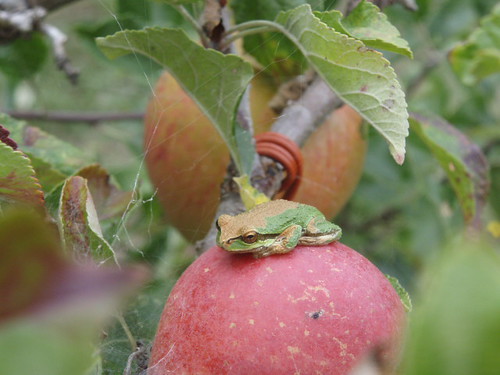
We work hard getting the apples sorted out during the course of a day. Its tough work with a 20kg bag hanging off you whilst climbing and picking. Keeping the effort to a couple hours at a time with lots of little breaks helps to stave off fatigue and injury. Wild life abounds here, and there is always something to see while out in the orchard. There are raccoons, bald eagles, kingfisher, deer, green tree frogs and little snakes everywhere. The insect life is phenomenal, and I love watching the dragonflys skim over the lake and do their dance. It surprises me how many spiders there are too. Bigger than I remember, which is not a problem now that I have seen the Huntsman and Redbacks of Australia or the scorpions of Jordan.
The first two weeks were full of apples, swimming and fishing. Now that it's a lot cooler it's kayaking, fishing, mushroom picking and of course apples. We take the apples to farmers markets on the weekends, which are a lot of fun, and it is great to see so many conscientious vendors. Busy markets at the end of busy picking weeks makes for some long hours, but at the end of the day in the crowds I feel charged up with plenty of zing left over. Life is good here and we can't wait to share it with our friends when they are ready to visit us.

- Tanya